
A landlocked city where most homes date from the 1970s and 1980s
Concrete Contractors in Tempe, AZ
Driveway, patio, pool deck, walkway and slab work for north Tempe's older blocks and south Tempe's single-family neighborhoods.
- Free on-site estimate with measurements and a drainage check
- Written, itemized quote: base, thickness, steel, finish and joints
- Summer pours scheduled for early morning with a written cure plan
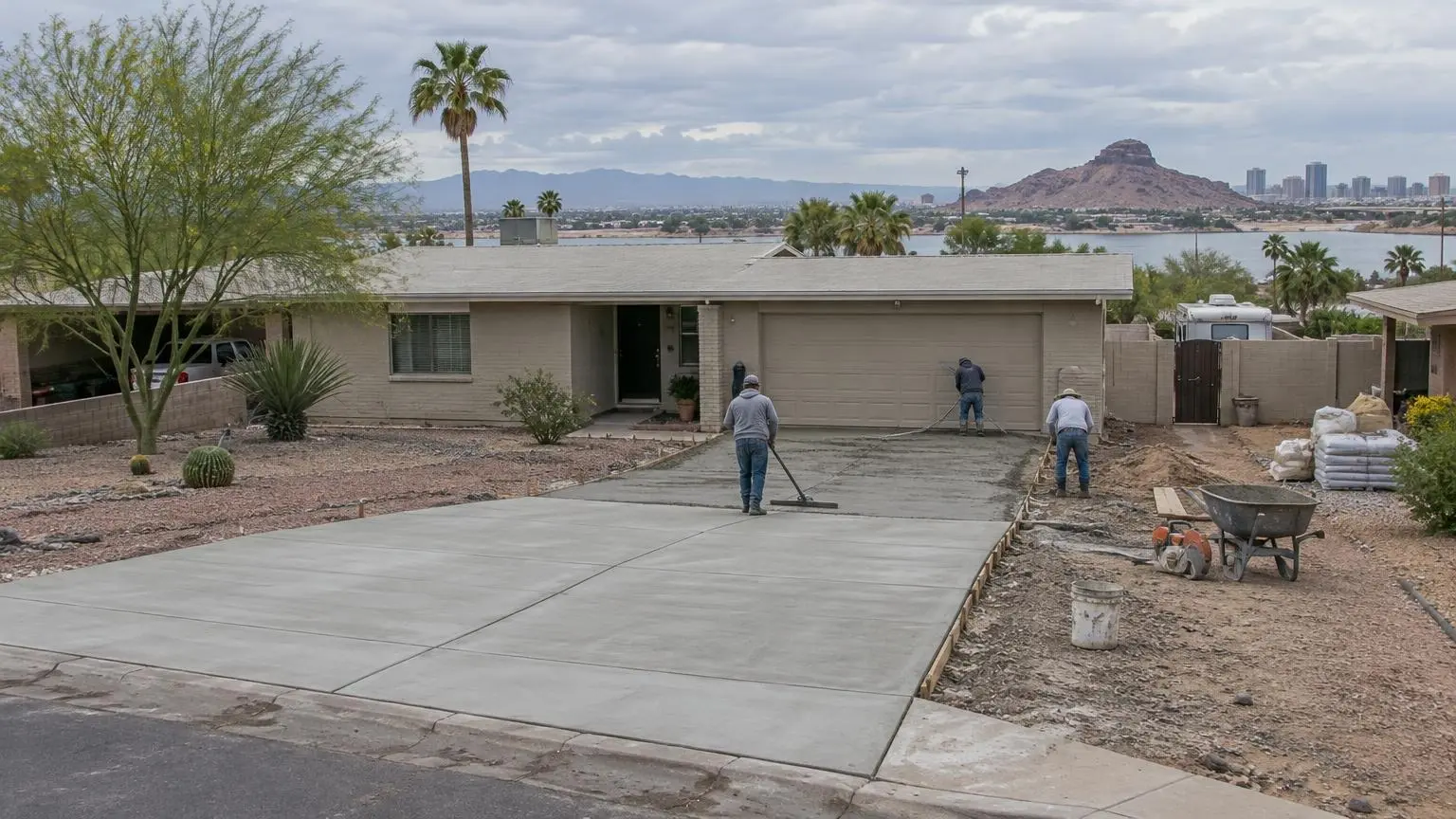
Concrete Work in Our Home City
Tempe is our home market, and the concrete contractors on our crew know its streets well. The city covers about 40 square miles of land and Wikipedia calls it "the landlocked city": with neighbors on every side, there is very little open land left to build on. Tempe had 7,684 residents in 1950, 63,550 in 1970 and 180,587 in 2020. Nearly all of its growth came in a few busy decades, and that is exactly why so much of the city's concrete now needs attention.
Most Tempe flatwork is 35 to 55 years old
Census data summarized by Point2Homes puts the median Tempe home at 1984. About 12 percent of homes were built in the 1960s, 24 percent in the 1970s and 22 percent in the 1980s. Only about 14 percent date from 2010 or later. In practice, that means a large share of the driveways, patios, walks and pool decks we look at were poured between 1965 and 1990.
Concrete from those years tends to show the same set of problems:
- driveways cracked across the middle where no control joint was cut, or where joints were spaced too far apart
- aprons broken at the street, where the slab is thinnest and the load is highest
- patios poured thin, with no reinforcement, now split into pieces or tipped toward the house
- pool decks pulling away from the coping, with cracks spreading from corners and drains
- front walks lifted by tree roots after decades of irrigated landscaping
We look at each slab on its own. If a driveway has one bad panel and the rest is level and sound, we saw-cut at the joints and replace just that panel. If the base has washed out or the slab is breaking up in several places, we recommend a full tear-out with a fresh, compacted base.
North Tempe and south Tempe are different jobs
Wikipedia describes north Tempe as fairly dense and urban, especially near the light rail line, while south Tempe is mostly single-family homes, strip malls and lower-density office parks. Only about 38 percent of Tempe's housing is single-family detached, and about 42 percent of homes are owner-occupied, a lower share than in most nearby cities.
In north Tempe, we often work on older homes on smaller lots near downtown and ASU, and on rental houses where an owner needs walks and steps made safe. In south Tempe, the typical job is a 1970s or 1980s house with a two-car driveway, a backyard patio and often a pool: replacement driveways, bigger patios and new pool decks are the most common requests there.
Historic neighborhoods near downtown
Tempe's history goes back further than its growth curve suggests. The 13th Arizona Territorial Legislature chose Tempe in 1885 as the site of the Territorial Normal School, which became Arizona State University. Older blocks near downtown include the Roosevelt Addition Historic District, listed on the National Register, and the Goodwin Addition, where the Carns-Buck House went up in 1914. The Arizona Preservation Foundation named the Maple Ash neighborhood as endangered in 2012.
For individually listed properties and homes in designated historic districts, Tempe's Historic Preservation Office reviews exterior changes, and there is no cost for that review. The city says rear patios, patio covers and most work entirely behind the main building or out of view from the street may qualify for a simpler Certificate of No Effect. Work that changes how the front of a historic property looks, such as a new driveway or front walk, may need a fuller review. We check with the office before we plan visible work on a historic home, and we favor plain broom finishes and joint layouts that suit older houses.
Heat, swings and storms
Tempe's July mean high is 105.9 degrees, and the record is 119. Wikipedia also notes that Tempe has a wider daily temperature swing than neighboring Phoenix. A slab that heats up all afternoon and cools at night is constantly expanding and shrinking, which is why joint spacing and joint depth matter so much here. Rain averages only 8.80 inches a year, but much of it comes in short, heavy summer storms, and Tempe has seen severe weather: an F2 tornado on August 30, 1971 injured 41 people.
On every Tempe pour we:
- schedule summer work at first light so finishing is done before the worst heat
- use a mix suited to hot weather and keep the slab damp or sealed while it cures
- cut control joints the same day at the spacing the slab thickness calls for
- slope patios and drives so storm water runs away from the house and toward the yard or street
Ground from the river to the butte
Tempe's elevation ranges from about 1,140 feet at Tempe Town Lake, where the Salt River is dammed in two places to hold the lake, to 1,495 feet at the top of Hayden Butte. Most residential lots are on flat valley ground, where drainage depends entirely on the grade we build into a slab. On older lots that have been irrigated for decades, we often find soft soil under the edges of driveways and patios. We dig out what will not compact and build a proper base before we pour.
Permits and paperwork in Tempe
Tempe's Building Safety Division runs the city's Permit Center, and permit applications go through the Citizen Access Portal. Whether your project needs a permit depends on what it touches. Work at the curb, the public sidewalk or the driveway approach is different from replacing a backyard patio, and a slab that will carry a patio cover is different again, because Tempe requires a building permit and plans for patio cover additions. We confirm what your job needs with the city before we schedule it. If your neighborhood has an HOA, we plan the design within its rules too.
What we pour across Tempe
- Driveways: tear-outs, replacements, widening and new aprons
- Patios: new slabs, extensions and decorative finishes
- Pool decks: replacement decks and cooler surface coatings
- Walkways and steps: front walks, side paths, stoops and entry steps
- Slabs: shed pads, equipment pads and slabs ready for a patio cover
- Repair: section replacement, trip edges, sunken panels and cracked aprons
Call (480) 769-5260 to set up a free visit anywhere in Tempe, from the neighborhoods around downtown to the south end of the city.
Tempe Facts That Shape a Concrete Job
- Landlocked city. Tempe has about 39.94 square miles of land, is described on Wikipedia as "the landlocked city" and had 180,587 residents in 2020.
- Housing age. The median Tempe home was built in 1984; about 24 percent date from the 1970s and 22 percent from the 1980s.
- Historic review. Tempe's Historic Preservation Office reviews exterior work on listed and district properties at no cost; rear patios may qualify for a Certificate of No Effect.
- Weather. The July mean high is 105.9 degrees, the record is 119 degrees and rain averages 8.80 inches; Tempe has a wider daily temperature swing than Phoenix.
- Elevation. Ground rises from about 1,140 feet at Tempe Town Lake to 1,495 feet at the top of Hayden Butte.
- Housing mix. About 38 percent of Tempe housing is single-family detached and about 42 percent of homes are owner-occupied.
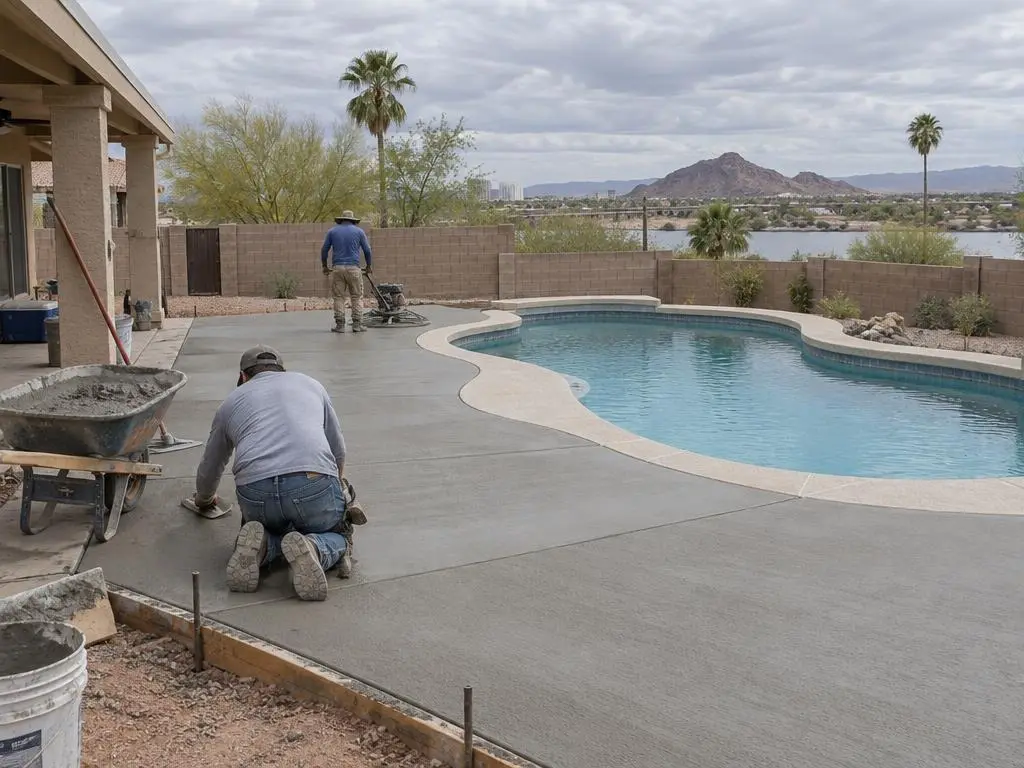
Tempe Questions
Do I need a permit to replace my driveway in Tempe?
It depends on what the work touches. Replacing a slab on your own lot is different from work at the curb, the public sidewalk or the driveway approach. We confirm requirements with Tempe's Permit Center before we schedule.
My home is in a Tempe historic district. Can I still replace my patio?
Usually, yes. The Historic Preservation Office reviews exterior work in designated districts at no cost, and rear patios are listed as work that may qualify for a Certificate of No Effect. Front-yard work may need a fuller review.
Why does my 1970s Tempe driveway have a crack right down the middle?
Many older slabs were poured with too few control joints, so the concrete cracked where it wanted to. If the slab is still level, we may replace the cracked panels; if not, a full replacement with proper joints is the better fix.
Can you pour a slab now for a patio cover later?
Yes. Tempe requires a building permit and plans for patio cover additions, so we can pour the slab with the cover's footings planned in so you do not have to cut new concrete later.
Free Estimates in Tempe, AZ
Tell us your Tempe neighborhood and what the concrete is doing, and we will set up a free on-site estimate.
Concrete Contractors Near Tempe
- Concrete Contractors in Mesa, AZ
- Concrete Contractors in Chandler, AZ
- Concrete Contractors in Gilbert, AZ
- Concrete Contractors in Scottsdale, AZ
- Concrete Contractors in Phoenix, AZ
- Concrete Contractors in Ahwatukee, AZ
- Concrete Contractors in Guadalupe, AZ
- Concrete Contractors in Paradise Valley, AZ
- Concrete Contractors in Fountain Hills, AZ
- Concrete Contractors in Queen Creek, AZ
- Concrete Contractors in San Tan Valley, AZ
- Concrete Contractors in Apache Junction, AZ
- Concrete Contractors in Gold Canyon, AZ
- Concrete Contractors in Sun Lakes, AZ
- Concrete Contractors in Glendale, AZ
- Concrete Contractors in Laveen, AZ
- Concrete Contractors in Avondale, AZ
- Concrete Contractors in Tolleson, AZ
- Concrete Contractors in Peoria, AZ
- Concrete Contractors in Dobson Ranch, AZ
- Concrete Contractors in Lehi, AZ
- Concrete Contractors in Leisure World, AZ
- Concrete Contractors in Maryvale, AZ
- Concrete Contractors in Higley, AZ